Getting your website to the top of Google has always been one of the main goals of Search Engine Optimisation (SEO). But with the rise of Google AI Overviews, the top of the search results page now looks a little different.

Instead of only seeing paid ads and organic links, users are often shown an AI-generated summary before they reach the traditional results. These summaries pull together information from different sources to give users a quick answer to their search query.
If your website is cited in an AI Overview, your brand can appear right at the top of the search results without paying for sponsored ads. That can be great for visibility, trust and brand awareness. But if the AI Overview answers the user’s question fully, they may not need to click through to your website at all. This could mean less website traffic and therefore the user doesn’t see the key details you want them to see.
What are Google AI Overviews?
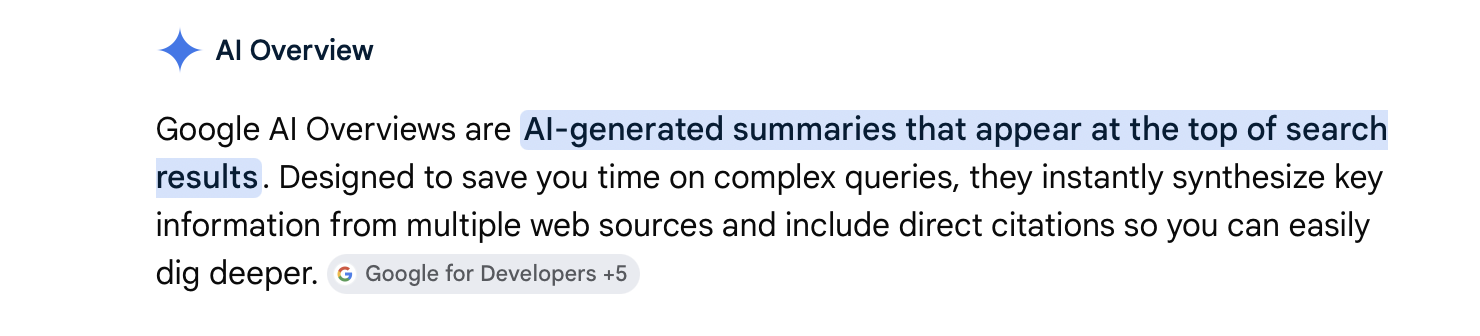
Google AI Overviews are AI-generated summaries that appear for certain searches. They are designed to give users a helpful answer quickly, using information from multiple online sources.
They often appear for question-based or research-led searches. These are usually searches where the user is still learning, comparing options or trying to understand a topic before making a decision.
Why AI Overviews matter for SEO
Businesses have traditionally focused on ranking as high as possible in the organic results. That is still important, but AI Overviews add another layer. Now, the aim is not only to rank well, but to create content that Google can understand, trust and potentially use within an AI-generated answer.
Google has said that its existing SEO best practices still apply to AI features like AI Overviews. In simple terms, there is no special trick or guaranteed shortcut to get into the AI box. Your website still needs strong content, good technical SEO, clear structure and reliable information.
This is also where terms like AEO, GEO and LLM visibility are starting to become part of the wider SEO conversation.
Answer Engine Optimisation (AEO) focuses on answering questions clearly. Generative Engine Optimisation (GEO) looks at how content is understood by generative AI tools. LLM visibility, meaning visibility within Large Language Models, considers how brands may appear in AI-led platforms such as Google’s AI features and tools like ChatGPT.
For most businesses, these are not separate strategies from SEO, but part of the same goal: creating useful, trustworthy content that can be found, understood and referenced.
Are AI Overviews good for website traffic?
Being cited in an AI Overview can be great for brand visibility. It puts your business in front of users at the very top of the search results and can position your website as a trusted source.
However, visibility does not always mean traffic. Pew Research found that when users saw an AI summary, they clicked on a traditional search result in 8% of visits, compared with 15% of visits when no AI summary appeared. It also found that users clicked a link inside the AI summary itself in only 1% of visits.
That suggests AI Overviews can reduce clicks, especially when the user gets the answer they need straight away.
This does not mean businesses should ignore AI Overviews. It means they should understand where AI Overview visibility is most valuable.
AI Overviews and search intent
AI Overviews are often most useful for awareness and consideration-led searches, where the user is still learning about a topic, comparing options or trying to understand what matters before taking action.
For example:
Top of funnel: “What makes a classic car valuable?”
The user is at the awareness stage. They may not be ready to buy yet, but they are learning about the subject and beginning to understand what factors influence value.
Middle of funnel: “Best classic cars to invest in under £30,000 UK”
The user is now comparing options and becoming more specific about what they are looking for.
Bottom of funnel: “Classic Porsche 911 for sale UK”
The user may be ready to enquire or buy, so they need actual stock, prices, location details, reviews and an easy enquiry process.
For the first two searches, appearing in an AI Overview could help build trust and awareness. For the final search, the user probably needs actual stock, prices, location details, reviews and an easy enquiry process.
This is why businesses should not chase AI Overviews for every keyword. The better question is: Would being included in the AI Overview help this stage of the customer journey?
How to improve your chances of appearing in Google AI Overviews
There is no guaranteed way to appear in Google AI Overviews, but there are some clear steps that can help.
Answer the question clearly.
If someone searches “Are classic cars a good investment?”, do not hide the answer halfway down the page. Start with a clear response, then explain the details directly underneath.
Use headings that match real searches.
Instead of a vague heading like “Things to know”, use something clearer, such as “Are classic cars a good investment?” or “What affects the value of a classic car?”
Make the content easy to scan.
Use short paragraphs, bullet points, FAQs and simple summaries. For example, a blog on classic car investment could include a quick list of factors such as condition, rarity, mileage, service history and market demand.
Add real expertise.
Google and users both need a reason to trust your content. Add expert comments, real examples, client experience or original insight. Instead of saying “classic cars can increase in value”, explain which types of cars tend to hold interest and why.
Link to the next step.
If the blog is educational, connect it to something useful, such as a service page, product category, enquiry form or related guide. This helps move the user from research to action.
Keep traditional SEO strong.
AI Overview visibility should not replace normal SEO. Your pages still need strong title tags, meta descriptions, internal links, fast loading speeds, mobile-friendly design and useful content.
Is traditional SEO still important?
Yes. Traditional SEO is essential. AI Overviews may change how users interact with Google, but they do not remove the need for strong organic rankings, useful content and well-optimised pages.
Ranking first on Google still matters. But now, the bigger question is whether your content is useful, trustworthy and structured enough to be part of the answer.
If you want to improve your website’s SEO strategy that works for both traditional search and AI-led results, get in touch.
Our team can help you build clear, search-focused content that supports visibility, trust and real business enquiries.